
| MAIN BIOGRAPHIES |
|
Nelson Algren |
|
Neal Cassady |
|
Raymond Chandler |
|
Edward Dahlberg |
|
William Browning Spencer |
|
Olaf Stapledon |
|
Alan Turing |
|
Emiliano Zapata |
|
|

"My life belongs to me - only my books belong to the public."
B. Traven
Biographical Notes for B. Traven
B. Traven was born in Chicago, Illinoison March 5th, 1890 to Swedish parents. He spent his youth in Germany,where he began writing leftist / anarchistliterature under the assumed name of Ret Marut,and eventually published an underground anarchist magazine, Der Ziegelbrenner, (The Brick Burner) . Traven was forced to flee Germany under the threat of a death sentence issued by the post-World War freikorps of Bavaria.
He disappeared for a time only to reappear in a British prison (crime unknown). After vanishing from London, a man calling himself B. Traven, began sending manuscripts in German to Das Buchengild, a German publisher.
Sometimes shown as Bernard Traven in his film credits, he is conversely shown as 'Bruno' Traven in the copyright listing of the Mexican edition of his books. The only thing that is certain is that this name was yet another alias.
Traven settled in Mexico sometime in the twenties, shortly after the reign of dictator Porfirio Diaz.
(See City of Mexico in the Age of Diazfor more information regarding the political climate of Mexico of this time.)
Traven's second novel, The Treasure of the Sierra Madre,was written during these first years in Mexico. First published in Germany in the 1930's, Treasurerapidly gained worldwide recognition and attention, and though his books had been published in many other languages, none had ever appeared in either Englandor the United States.
In 1934, both The Death Ship: The Story of an American Sailorand The Treasure of the Sierra Madrewere finally published in the United States.
Death Shipis an almost humorous story of an American sailor who loses his birth certificate and all other means of proving he is a real person to the authorities (his physical presence does not accomplish this.) In post-World War I Europe it is a crime to travel without proper identification and the sailor is forced to take passage on a decrepit steamer in a spiraling descent into Hell.
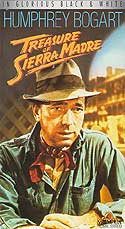
Treasurecaught director John Huston'sattention, but it was not until 1948, that the filmwas finally made.
During the filming, Hustoninvited Traven to visit, but the author declined, electing instead to send an 'agent', a man
 who identified himself as"
Hal Croves."Naturally, Hustonsuspected that this agent was the author himself, but it wasn't until after Traven's death in 1969, when pictures of the reclusive man were published that John Huston confirmed Croves "true" identity. (After all, 'Traven' was simply another alias.)
who identified himself as"
Hal Croves."Naturally, Hustonsuspected that this agent was the author himself, but it wasn't until after Traven's death in 1969, when pictures of the reclusive man were published that John Huston confirmed Croves "true" identity. (After all, 'Traven' was simply another alias.)
The film of course, went on to become one of the greatest films of all time ( American Film Institutefilm rank #21), with one the immortal lines of cinema:
"Badges? We ain't got no badges! We don't need no badges! I don't have to show you anysteenkin' badges!".
Starring Humphrey Bogart, Tim Holt,and Walter Huston.For those of you who enjoy trivia, the rich American who gives Fred C. Dobbs ( Humphrey Bogart)money three times in the same day, is none other than the director, John Hustonhimself.
The film paints a not so pleasant portrait of Americans in a Depression era Mexico, which was particularly unusual in a post-World War IIUnited States. It is perhaps, in part, the grim honesty with which the story is told that accounts for its enduring vitality.
In the 1960's, the publishers Hill and Wang began publishing the significant body of Traven's work in the United States, including his excellent 'Jungle' Series.
Traven's anarchistic ideology is a central theme throughout his writing, illustrating the victimization of individual freedom by the crushing power of the State. His philosophy however, is nowhere near as overwhelming and weighty as it is in other authors such as, say Ayn Rand.
Traven's sympathy for the indigenous people of the Chiapasregion of Mexico caused him to learn their native Mayandialect. Traven's writing skills shine through consistently in this Jungle series, which outlines the birth of the Mexican Revolution,by compassionately, and unsparingly describing the terrible plight of the indigenous people in the mahogany forests of Chiapas. Treated worse than slaves by greedy plantation owners who manipulated the laws of peonage (which had actually been declared illegal by the government) through the use of debt-slavery, bribery and other methods during the reign of dictator Porfirio Diaz, Traven's depiction of brutalized Indians breaking their backs and driving oxen through hazardous jungle and marsh and floating or hauling tons of mahogany to the monteria, (mahogany plantations), through thorns, mud, rain, biting blood-filled flies and ticks, whips and beatings.
The Jungle series is a social realist nightmare, but an unfortunately true accounting of an incredibly dark period of Mexico's history. The series includes the novels: The Bridge in the Jungle; Trozas(Spanish for tiny pieces); March To Monteria; The Rebellion of the Hanged; The General From the Jungle; The Carreta(Spanish for carriage or cart).
Traven was at times perhaps extreme in his obsession for keeping his true identity secret, but from his past experience, in both Germany and again in England, who could truly blame him. After his death in 1969, his ashes were scattered in Chiapas, and his widow (and Spanish translator of his writings),
Rosa Elena Lujan,was instructed to reveal his identity as "B. Traven", "Ret Marut", "Hal Croves", et cetera.
Bibliography
US publishing dates in brackets. Note: 'n/a'=date not available
-
Death Ship: The Story of an American Sailor [1934]
-
The Treasure of the Sierra Madre [1934]
-
The Carreta [1935]
-
The Bridge in the Jungle [1938]
-
Rebellion of the Hanged [1952]
-
The Night Visitor and Other Stories [1966]
-
The Cotton-Pickers [n/a]
-
The General From the Jungle [n/a]
-
The Government [n/a]
-
The March to Monteria [n/a]
-
Macario (edition only available in Spanish) [n/a]
-
Trozas [n/a]
-
To the Honorable Miss S : And Other Stories from the Brick Burner [n/a]B. Traven's writings as 'Ret Marut'. (Currently out of print)
Biography
Biography
-
My Search For B. Traven. By Jonah Raskin. Methuen 1980. (Currently out of print.) Raskin set out to write a biography of a writer he greatly admired. After almost a year at Traven's home and in the jungles of Chiapas, he came to his senses and wrote this book instead.
-
B. Traven : A Vision of Mexico (Latin American Silhouettes)by Heidi Zogbaum Scholarly Resources
-
The Mystery of B. Traven(Currently out of print.)by Judy Stone. 1977. William Kaufmann. Stone was the first of the Americans to actually track Traven down to Mexico and spend time with Traven and Rosa Elena Lujan.
-
The Secret of the Sierra Madreby Will Wyatt. N.Y.,1980. Doubleday. Wyatt went further than any of Traven's chroniclers up to that date. Wyatt also produced the BBC documentary of the same name on Traven.
-
Mister Traven, I presume?Michael L. Baumann. Author claims to have proven that B. Traven was 2 different people, one an American, who wrote the Treasure of the Sierra Madre, and the other a German who stole the name and used it until his death in 1969.
Filmography
Filmography
-
Bridge in the Jungle, The (1970)
-
Totenschiff, Das (1959)
... aka Mutinos de York, Les (1959) -
Canasta de cuentos mexicanos (1956)
-
Rebelión de los colgados, La (1954)
... aka Rebellión of the Hanged, The (1954) -
Treasure of the Sierra Madre, The(1948)
-
BBC Film Documentary "The Secret of the Sierra Madre" (directed by Will Wyatt)
Net Links
-
Tapio Helen's excellent research on B. Traven, which dispels many of the myths, unsubstantiated theories and hoaxes about the mysterious authors, many of which have been inadvertently presented as fact in this biography: www.helsinki.fi/hum/hist/yhd/julk/traven01/
-
http://www.kirjasto.sci.fi/traven.htm: Finnish resource for hundreds of authors. Lots of Traven info.
"This is the real world, muchachos, and you are in it."
Author: Patrick Deese